Published Date -

What is SharePoint? A Complete Guide to How it Helps Businesses Work Smarter.
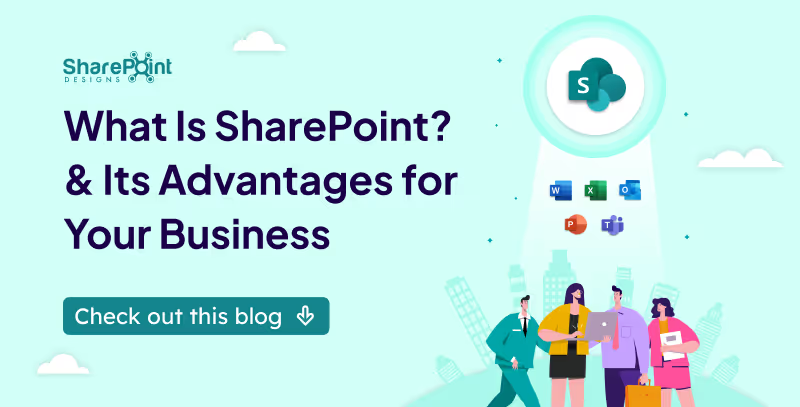
Most organizations know SharePoint as a place to store files. But the businesses that get real value from it use SharePoint very differently.
They use it to:
- Reduce email overload
- Centralize knowledge
- Automate everyday processes
- Support hybrid and remote work
- Create a single digital workplace employees actually rely on
This article explains what SharePoint is, and more importantly, how it helps businesses improve collaboration, productivity, and information management in real-world scenarios.
What is SharePoint?
SharePoint is a web-based platform from Microsoft that helps organizations store, manage, share, and collaborate on information securely.
Over time, it has evolved from a basic file-sharing tool into a full digital workplace platform that supports:
- Intranets and internal portals
- Document management with version control
- Team and department sites
- Workflow automation
- Integration with Microsoft 365 tools
Today, SharePoint acts as a central layer that connects people, content, and processes across the organization.
Why Businesses Use SharePoint (Beyond File Storage)
The real value of SharePoint lies in how it brings structure to everyday work.
Instead of scattered files, emails, and disconnected tools, SharePoint provides a single source of truth where teams can collaborate with clarity and control.
This combination makes SharePoint especially valuable for growing and distributed teams.
How SharePoint Improves Everyday Workflows
In many organizations, work slows down because information lives in too many places.
SharePoint simplifies this by bringing documents, discussions, and processes together.
Practical workflow improvements include:
- Teams collaborating on the same document without email attachments.
- Automated approval flows replacing manual follow-ups.
- Department sites replacing shared drives.
- Clear ownership and visibility over content.
When structured properly, SharePoint reduces friction rather than adding another tool to manage.
SharePoint and Microsoft 365: Why the Integration Matters
SharePoint works best when used as part of the Microsoft 365 ecosystem.
This means:
- Files created in Word, Excel, or PowerPoint are stored and managed in SharePoint
- Teams channels use SharePoint behind the scenes for file collaboration
- Outlook notifications keep users informed without extra tools
For employees, this feels seamless. For IT and business leaders, it means better governance and consistency.
SharePoint Intranet: A Central Hub for the Organization
One of the most common and effective uses of SharePoint is building an intranet.
A SharePoint intranet gives employees:
- A single-entry point for company news and updates
- Access to policies, forms, and resources
- Department-specific information
- Searchable knowledge bases
Instead of relying on emails or shared folders, employees know exactly where to go for information.
Modern vs Classic SharePoint: What Businesses Should Know
Organizations often ask whether they should use Classic or Modern SharePoint.
Here’s the practical answer:
- Classic SharePoint is stable but limited and not mobile-friendly
- Modern SharePoint is responsive, faster, and designed for today’s work patterns
Most businesses moving forward choose Modern SharePoint because it:
- Works well on mobile devices
- Integrates better with Microsoft 365
- Supports modern layouts and user experiences
For a deeper comparison, read our guide on Classic vs. Modern SharePoint sites and how to choose what fits your organization.
Content Management and Governance with SharePoint
For content-heavy organizations, SharePoint provides strong controls without complexity.
Key capabilities include:
- Metadata-based organization instead of folders
- Automated content updates and lifecycle management
- Brand consistency across sites
- Permission-based access without duplication
This makes SharePoint suitable for HR, communications, legal, and knowledge-driven teams.
Microsoft Teams and SharePoint: How They Work Together
Microsoft Teams and SharePoint are not separate tools competing with each other.
They work together.
- Teams handles conversations and collaboration.
- SharePoint manages files, pages, and structure.
When used together, teams can collaborate in real time while keeping content organized and secure in the background. For a deeper look at how this integration works in practice, our guide on integrating SharePoint with Microsoft Teams breaks it down step by step.
Is SharePoint Right for Every Business?
SharePoint works best for organizations that:
- Need structured collaboration.
- Manage a growing volume of documents.
- Support hybrid or remote teams.
- Want to standardize processes and communication.
It’s not just about adopting SharePoint, but about designing it around how people actually work. If you’re evaluating external support, this guide on hiring the right SharePoint consultant explains what to look for and when it makes sense.
Final Thoughts: Using SharePoint as a Business Platform
SharePoint is no longer just a document repository. Used well, it becomes a business platform that supports collaboration, communication, and operational efficiency.
The organizations that succeed with SharePoint don’t treat it as an IT project. They treat it as a digital workplace strategy.
How SharePoint Designs Helps
At SharePoint Designs, we work with organizations to:
- Design and optimize SharePoint intranets
- Plan and execute SharePoint migrations
- Align SharePoint with real business workflows
If you’re reviewing how SharePoint fits into your digital workplace strategy, seeing how proven patterns are applied in practice can often help clarify the next steps.
faqs

Venkatesh Maran

Founder and CEO of SharePoint Designs, a Microsoft ISV with 6 products live on AppSource. We build products that solve the problems Microsoft left on the table. Intranets that people actually use. Document management systems that don't fight your workflows. Knowledge platforms that surface what matters. And now, AI agents built on Microsoft Copilot that take the repetitive work off your team's plate. Every product we build gets designed around your brand, your culture, and how your teams actually work. Trusted by enterprises across 23 countries, primarily in the US and Europe, with deep expertise in SharePoint, Power Platform, Microsoft Copilot, and Microsoft 365. Over 15 years in the ecosystem and still going. Our mission is simple: make work more fun.



.svg)